MENU PRICING · DECISION GUIDE
Menu pricing calculator.
Menu pricing calculator
Price a dish from its plate cost: by food cost target, by dollar margin, and for delivery apps. The example is the stir-fry worked below.
- Menu price
- $9.73
- Delivery app price
- $12.98
- Formula used
- Food cost target (plate cost is at or below the crossover)
- Price at the food cost target
- $9.73
- Price with the dollar margin
- $9.92
- Crossover plate cost
- $3.00
- Delivery markup to keep the same
- 33.3%
A menu price needs three numbers: the plate cost, the share of the price you keep after fees, and either a food cost target or a dollar margin. For Kevanto's stir-fry example, a $2.92 plate, a 30% food cost target gives $9.73. On a 25% delivery plan the same dish has to be $12.98 to leave the same $6.81.
Which formula to use depends on the plate cost and the channel. The table below is the short answer; the sections after it show the arithmetic.
| Situation | Use | Formula |
|---|---|---|
| Most dishes with a plate cost near your average | Food cost target | price = plate cost ÷ target |
| Expensive plates (above the crossover, $3.00 here) | Dollar margin | price = plate cost + dollars you need per plate |
| Delivery or pickup apps | Keep the same remainder | app price = dine-in price ÷ (1 − commission) |
| Menus that include VAT or GST | Remove tax first | see the costing guide |
The example dish
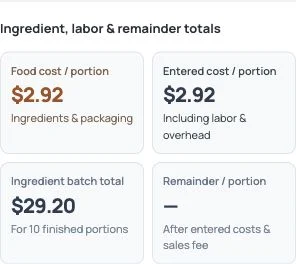
The stir-fry serves 10 with chicken thighs, broccoli, carrots, onion, pepper, rice, soy sauce and oil. Its prices are illustrative classroom numbers, the same ones the printable worksheet uses, so you can check every line on paper. The batch costs $29.20, $2.92 a plate.
Food cost percentage or dollar margin?
A percentage target scales the margin with the plate: a $9.00 steak plate at 30% must sell for $30.00, leaving $21.00. A dollar margin adds the same amount to every plate: with $7.00 per plate the steak sells for $16.00. The two agree at one plate cost:
crossover plate cost = margin × target ÷ (1 − target) = $7.00 × 0.30 ÷ 0.70 = $3.00
| Plate cost | Price at 30% food cost | Price at $7.00 margin | Higher price from |
|---|---|---|---|
| $2.00 | $6.67 | $9.00 | Dollar margin |
| $3.00 | $10.00 | $10.00 | Same |
| $4.00 | $13.33 | $11.00 | Food cost % |
| $6.00 | $20.00 | $13.00 | Food cost % |
| $9.00 | $30.00 | $16.00 | Food cost % |
Below the crossover the dollar margin asks more; above it the percentage does. Pricing every plate by percentage can push premium plates to prices your guests will not pay, and cheap plates may not cover the labor of making them. One way to handle both is a percentage target for most of the menu, with a dollar floor for cheap plates and a dollar margin for expensive ones.
Delivery app prices, plan by plan
Commission is taken from the item price. To leave the same $6.81 per plate as dine-in, divide the dine-in price by what you keep. Commission rates from the DoorDash and Uber Eats U.S. merchant pricing pages:
| Plan | Commission | Price for the same remainder | Above dine-in |
|---|---|---|---|
| DoorDash Basic, delivery | 15% | $11.45 | +17.6% |
| DoorDash Plus, delivery | 25% | $12.98 | +33.3% |
| DoorDash Premier, delivery | 30% | $13.90 | +42.9% |
| DoorDash pickup | 6% | $10.35 | +6.4% |
| Uber Eats Lite, delivery | 20% | $12.17 | +25.0% |
| Uber Eats Plus, delivery | 25% | $12.98 | +33.3% |
| Uber Eats Premium, delivery | 30% | $13.90 | +42.9% |
| Uber Eats pickup | 7% | $10.47 | +7.5% |
A 30% plan needs a price 42.9% above dine-in, not 30% above it. DoorDash says its 6% pickup rate requires pickup menu prices that match in-store prices, so a higher app menu would apply to delivery orders only. Check the current terms before you set two menus.
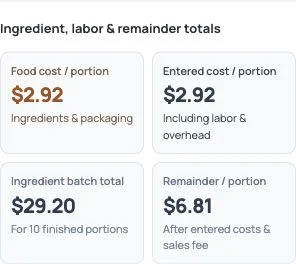
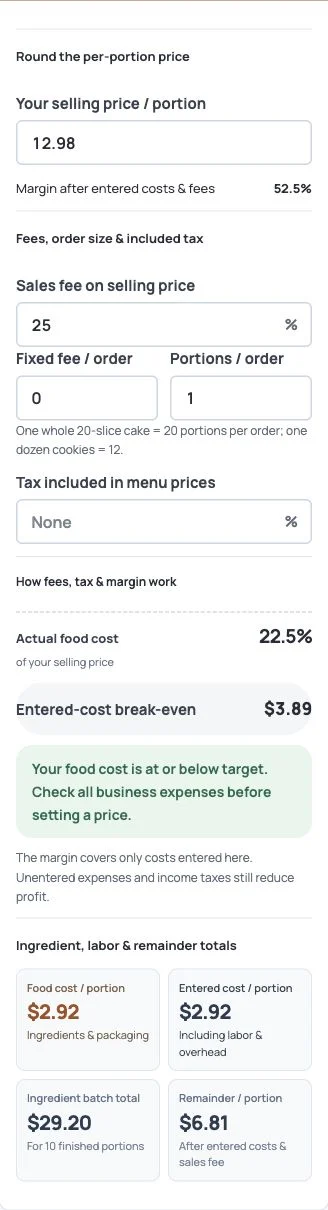
The remainder is not profit: rent, card fees on dine-in, packaging and staff are not in this example. Add the ones you know as overhead or ingredient rows (a takeout container is an ingredient with the unit each).
Sources
- DoorDash, Merchant pricing and commission rates (U.S.), read 30 October 2026.
- Uber Eats, Merchant pricing (U.S.), read 30 October 2026.